Article Summary
How does Dim-to-Warm Lighting Work?
Dim-to-warm lighting is an LED technology that shifts the color temperature to a warmer, more amber tone as the light is dimmed, replicating how incandescent and halogen bulbs naturally warm up when dimmed. It is also called warm dimming or black-body dimming.
Consumer lighting needs and real-world applications are continually evolving. LED tunable light technology has stepped up to the challenge by offering a range of lighting capabilities to create any desired atmosphere. This is achieved through warm dimming, also known as dim-to-warm or blackbody dimming.
The Science Behind Dim-to-Warm Lighting
Physicists created a theoretical reference source called a blackbody radiator. When heated, a solid object will glow and then shift in color. This trend will track continuously along the visual spectrum. The brightness of a given object can be measured as a function of a wavelength or its spectrum. The hotter an object burns, the more light it will generally emit at shorter wavelengths, and a cooler object will emit more light at longer wavelengths. This continuous spectrum has a broad peak that can be used to determine the object’s temperature. This spectrum is called a thermal spectrum or a black-body spectrum.
How Dim-to-Warm Compares to Standard Incandescent Dimming
Dim-to-warm simulates an incandescent ambiance by adjusting the LED color temperature as you dim the light. This type of lighting can be dimmed to a relaxing amber tone, similar to a candle’s. It provides the same warmth and glow as halogen dimming.
It is typically designed for 2700 to 3000 Kelvin at full output, with the correlated color temperature (CCT) decreasing as the output is reduced. This output can go down as low as 1800K (the color of candlelight). The light color becomes increasingly warm in appearance (more yellow and red) as the product dims.
For a side-by-side comparison of dim-to-warm against other LED color technologies, see the table below.
Dim-to-Warm vs. Tunable White vs. Standard Dimming
| Dimming Option | What changes as it dims | Color range | Best for | Control complexity |
|---|---|---|---|---|
| Dim-to-Warm | What changes as it dims Color temperature shifts warmer automatically | Roughly 2700K down to 1800K | Replicating an incandescent or candlelit feel | One signal controls both dimming and color together |
| Tunable White | Color temperature is set independently of brightness and can be adjusted on demand | Typically 2700K to 6500K, user-selectable | Spaces that need different color moods throughout the day | Requires separate intensity and color control signals |
| Standard Dimming | Only brightness changes; color temperature stays fixed | Fixed, usually 2700K or 3000K | Simple brightness control with no color shift needed | Single dimming signal only |
Applications for Warm-Dimming
Light color and the dimming quality of fixtures are highly valued in hospitality settings such as restaurants, hotel lobbies, guestrooms, ballrooms, and theaters. It is also an excellent addition to any residential space.
Dim-to-warm’s methodology can accentuate any area and bring out its best features. Warm-colored lighting can create the desired look and feel hospitality managers want their customers to experience. The light is reminiscent of home’s warmth and can be an effective way to create a calm, relaxing atmosphere for the clientele.
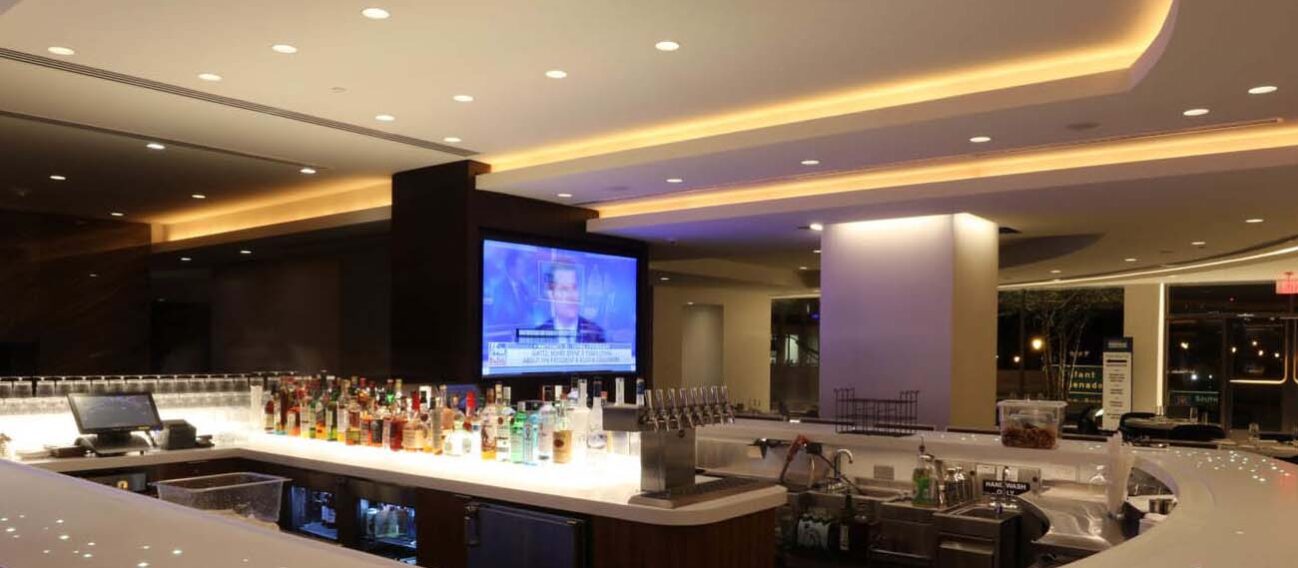
Dim-to-warm is also a natural fit for cove lighting installations, where a soft, warming glow along a ceiling perimeter reinforces a relaxed mood, and for restaurant or bar environments where lighting shifts from bright daytime service to a warmer evening atmosphere without changing fixtures.
Lighting Controls for Warm-to-Dim Fixtures
Dim-to-warm lighting requires at least three LED primaries to dim along the black-body curve, as with incandescent lighting.
This type of product’s dimming is associated with the color change, so there is only one control signal and, consequently, only one controller per group of luminaires that dim in unison.
Phase-Cut Dimming vs. 0-10V, DALI, and DMX
Some systems can accomplish this function with a phase-cut dimmer, where the dimming information is carried in the voltage waveform. This tactic may not have as much dimming resolution or smoothness as a control system using 0-10V, DALI, or DMX procedures. The latter three require separate wiring for the intensity/color signal and luminaire power.
For more details on how these protocols differ, see our lighting controls product line for 0-10V, DALI, and DMX compatible options.
H3: Wireless Control Options
Dim-to-warm luminaires can be equipped with a wireless receiver for control by a wireless transmitter via Zigbee, Wi-Fi, or Bluetooth, or hardwired to the facility power.
Explore Boca’s Smart Dimmer series or NanoRouter wireless controls for wireless dim-to-warm setups.
Frequently Asked Questions
What color temperature does the dim-to-warm start at?
Most dim-to-warm fixtures start around 2700K to 3000K at full brightness, then shift warmer as they dim, down to as low as 1800K, which matches the color of candlelight.
Is dim-to-warm the same as tunable white?
No. Tunable white lets you set color temperature and brightness independently at any time. At the same time, dim-to-warm automatically shifts to a warmer color only as the fixture is dimmed, with no separate color control needed.
Can dim-to-warm fixtures be controlled wirelessly?
Yes. Dim-to-warm luminaires can use a wireless receiver for control over Zigbee, Wi-Fi, or Bluetooth, in addition to standard hard-wired control options.
Why do dim-to-warm fixtures need three LED primaries?
Three LED primaries are needed so the fixture can trace the black-body curve accurately as it dims, reproducing the same gradual color shift toward amber and red that an incandescent filament produces naturally.
What is a black-body radiator?
A black-body radiator is a theoretical, perfectly efficient object that absorbs all light and energy that hits it and reflects none of it. As it heats up, it glows, emitting light in a predictable, continuous range of colors determined solely by its temperature, not by what it’s made of. This is the same principle dim-to-warm lighting is designed to mimic: as the fixture dims, its color shifts warmer along that same predictable curve, just as a heated object would. For a deeper scientific explanation, see the European Space Agency’s overview of black-body radiation.
Control the color temperature of light with Boca’s warm to dim products
Dim-to-warm lighting gives designers the warmth of incandescent dimming with the efficiency and lifespan of LEDs. It works by shifting the color temperature toward candlelight as brightness decreases, and it pairs with phase-cut, 0-10V, DALI, DMX, or wireless controls, depending on the project. Browse Boca’s Warm to Dim product line to find fixtures suited to your space.